How a ten-person fab shop tracks production
A small shop tracks production by keeping two things current: where each job is standing, and what is on the shelf. Simple Industry records both and does not schedule machines.
Write work down where it enters and leaves
Work in a small shop lives in people’s heads until someone writes it down. The habit that fixes this is small: record an order when it arrives, record a job when it moves on from a station, and count the shelf now and then.
Orders get worked earliest due first. An order with no due date has nothing to sort on, so give every order one.
Getting orders in
An order line is a quantity of one part for one customer. Lines that share an order number are one order, so they ship together.
Orders come in from a CSV file, typed by hand, or synced from a web store. The import shows a preview before anything is saved, and a later upload with the same order numbers updates the lines instead of doubling them. The orders list marks a late line in red.
Where each job is standing
The production board has one column per process your shop has named, in your shop’s own order, with Setup on the left and Ship on the right. A card is one part standing at one column.
When work is done at a station, someone taps Finish and types how many came off, and adds scrap separately if there was any. A strip along the top lists work that has sat at a station longer than usual, an order at risk of its due date, and a part out at a vendor past its return date. It does not send a text or an email about them.
Logging finished work adds the part to stock and takes its bill of materials components off the shelf. Nothing reaches the shelf until a part finishes its last station, so the board is not a count of what you have.
The board says where work is. It does not schedule anything or estimate how long a job takes.
What to make for stock
For parts you build ahead of orders, the make list works out days of cover: what is on the shelf, divided by how fast the part has been selling over the last 90 days, unless you changed that window in Settings. The part that runs out soonest is listed first.
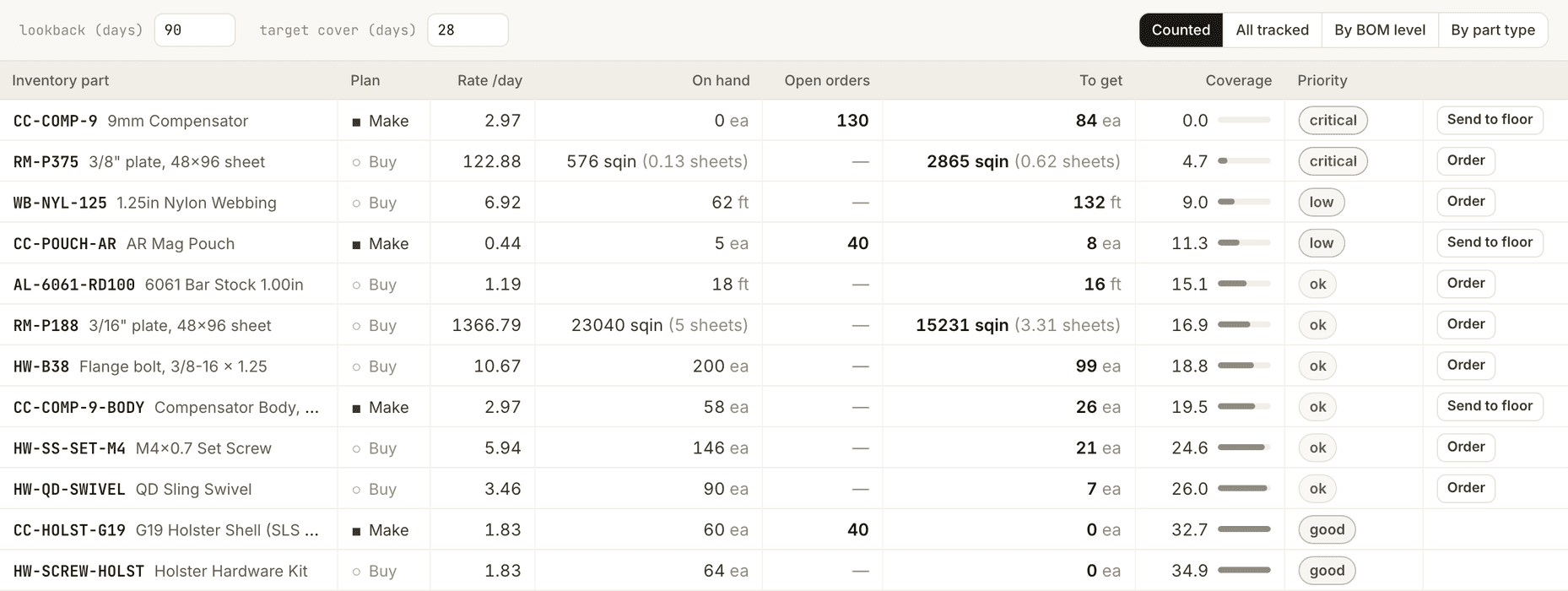
The suggested quantity is a suggestion. Nothing on the list schedules a machine or reserves material.
Tell us how work moves through your shop. We will set up a time to meet, in person or online.
Reach out to the founders